


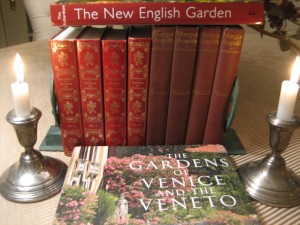
The 2014 Christmas Book List from The Garden Interior
1. “A Supremely Beautiful Look at Modern English Gardening”
The New English Garden, by Tim Richardson and Andrew Lawson.
Beauty is something universally admired by gardeners, as that is a fundamental part of their vocation, and what a supremely beautiful book this is. Written by Tim Richardson and photographed by Andrew Lawson, Jane Sabire and Rachel Warne, it is an intimate tour of 25 visually spectacular English gardens, all of which were either made or re-designed in the last ten years. Hence the “new” in the title. Weighing in at more than five pounds, it consists of 300-plus pages and is ten by twelve inches, and so is a solid coffee table book that demands to be left out for anyone interested to peruse. Each garden is covered in ten to fifteen sumptuous pages, and you could do much worse that to study one garden each day with your morning coffee, in these dark days of late fall and early winter.
Read the full review:
2. “Why Is Venice So Beautiful?”
Gardens of Venice and the Veneto, by Jenny Condie and Alex Ramsay.
Well yes, there is the obvious: the unique architecture, the strategic location at the top of the Adriatic at the first interface between Europe and the Near East and Far East. The wealth, the power and the history. But where did all that wealth and power and history come from? It came from commerce and a new kind of commerce, which was built up from scratch in an era when almost all wealth was agricultural and feudal, and was represented by a sack of turnips or a new-born calf in the barn.
The source of the wealth of Venice was business – it was fundamentally commercial and entrepreneurial. When the origins of modern commerce exploded out of the souk, the trading post and the village market in the late Middle Ages and the Renaissance, it had only a few really important DNA strands: the small but dynamic banks of Flanders and Florence, the seafaring capitals of northern Europe, the coffee houses of Amsterdam and England. And of course Venice, perhaps for centuries the very focal point of it all.
Read the full review:
3. “Personal Letters of Two Great Gardeners”
Dear Friend and Gardener: Letters on Life and Gardening, by Beth Chatto and Christopher Lloyd.
Now comes this wonderful book by two of our era’s most brilliant and accomplished gardeners. Beth Chatto built up the now celebrated Beth Chatto Gardens almost from nothing, just a wildly overgrown apple orchard at Elmstead Market in Essex. She holds the prestigious Victoria Medal of Honour from the Royal Horticultural Society (as does Lloyd) and received an OBE in 2002. She is one of the great stars of horticulture and has been featured in countless books and broadcasts, having written several books herself. Christopher Lloyd (invariably “Christo” to all who knew him) inherited and gardened at the world-famous home of Great Dixter in East Sussex. He was awarded the OBE in 2000. Lloyd was famous for his daring plant and color combinations; pairings that would seem insane to a less subtle gardener he made successful because of his superb plantsmanship and his great skill and daring. Photos of the gardens at Great Dixter are pored over by gardeners around the world, with admiration and envy, for their great originality.
Read the full review:
4. “Great Story, Masterful Story-Teller”
Joseph Banks: A Life, by Patrick O’Brian.
Joseph Banks was one of history’s most important botanists and naturalists and Patrick O’Brian is the prolific author of, among other things, the beloved Aubrey-Maturin saga of 20 nautical novels, of which “Master and Commander” was the first and became the popular movie starring Russell Crowe. So this pairing, Banks and O’Brian, places one of the world’s great life stories in the hands of one of the world’s best story-tellers. I am a huge fan of both O’Brian and Banks, so of course to me the combination was irresistible. And what a story it is. Banks was born into a wealthy and connected English land-owning family in the 18 th Century. Educated at Harrow, Eton and Oxford, he early on developed a passion for botany. He went on a very productive expedition to Newfoundland and Labrador when he was only 23, and he was bitten by the exploring bug. His father died when he was young, leaving him favorably circumstanced: rich, young, handsome, brave, energetic and gregarious. He became an early Fellow of the fabled Royal Society, one of the most celebrated collection of scientific geniuses ever assembled, and from that perch he landed the adventure of a lifetime.
Read the full review:
http://www.amazon.com/review/R1UEBLH16LQTW2/ref=cm_cr_pr_perm?ie=UTF8&ASIN=022661628 2
5. “One of England’s Great Gardening Classics”
Old Herbaceous: A Novel of the Garden, by Reginald Arkell.
You know, one of the really great things about gardeners is how wonderfully generous they are with advice, most of it rubbish of course and rarely is it advice they themselves follow in anything like a systematic way, as I have noticed. But every so often you pick up a nugget of great value from a gardening acquaintance, and experienced gardeners are always on the lookout for that. So here is something along the line of a pearl of rare price. If you have never read Old Herbaceous by Reginald Arkell, go out and buy this fine book immediately. It was written in 1950, near the end of the author’s long life, and it is a novel about a crusty old English gardener near the end of his own long life, looking back on what made him the gardener – and the man – he is now. You can just hear the lilting sing-song of the rural accents of the village characters; Arkell has captured them with perfect pitch. What a lovely and humane book this is, a gentle comedy enriched with sober observation on the practice and philosophy of gardening. It has the broad comedy of Beverley Nichols’ great gardening books but also their depth and perhaps a bit more gravitas. It is truly a gem and, though far too brief, something you will take to heart and cherish.
Read the full review:
http://www.amazon.com/review/R1V692D4U0HHI2/ref=cm_cr_rdp_perm
6. “Don “Draper Comes Clean”
Trust Me, I’m Lying: Confessions of a Media Manipulator, by Ryan Holiday.
If you got Don Draper of TV’s “Mad Men” really drunk on martinis and he unburdened himself of how he and his industry schemed and plotted to make consumers of the 60s do what they wanted them to do, this is what it would be like. Holiday dishes the dirt about the media manipulators’ tricks, scams, abuses, exploitation of weakness and their perverse and joyful disregard of what is true or good or even ethical, all in the pursuit of controlling social media and the broad audience of news viewers and product consumers. Yuck, what a messy business it is, too. Just in case you thought there was something not quite right about the link between social media and the news cycle, this book tells you how right your instincts are. The Financial Times calls it a “disturbing book”; well that’s a classic British understatement for sure.
Read the full review:
7. “Flower Arranging that Is Local, Seasonal and Brilliant”
Bringing Nature Home: Floral Arrangements Inspired by Nature, by Ngoc Minh Ngo.
The foreword to this book, by Deborah Needham, says its message is “a sonnet to the seasons. It rejoices in the beauties particular to each and to the immense joy to be had from paying witness to those changes, and of bringing its fruit into the home.” This lovely book is a collaboration between the celebrated lifestyle photographer Ngoc Minh Ngo (text and photos) and Nicolette Owen of Brooklyn’s famous Little Flower Shop (arrangements).
Its arrangements are typical of the “back to nature” esthetic movement, which showcases local and seasonal beauty harmoniously and ingeniously composed, without using either out-of-season flowers or rare floral and plant materials. But these arrangements, though composed sometimes of very ordinary materials, are anything but ordinary themselves. The inherent beauty of the simple is the guiding principle here, and Ngoc and Owen demonstrate how locally sourced materials, beautiful in themselves, achieve a holly new level of beauty through lush and artful combination.
Read the full review:
8. “Inventive How-To for Small-Sized Gardening”
The Edible Balcony: Growing Fresh Produce in Small Spaces, by Alex Mitchell.
It doesn’t get any more fresh, local and organic than this – flowers and produce grown on your own balcony or rooftop. Alex Mitchell is the English garden writer (Sunday Telegraph) and crusading gardener who has published this very interesting and highly entertaining book on making good use of very small spaces. Not everyone, after all, has broad acres of sunny garden space, but everyone wants to live well and eat well.
The reasons for balcony gardening are several and compelling, starting with the best and most important ones: because you want to and it’s just plain fun. More serious reasons are that it transforms often bare and ugly spots into attractive areas bursting with fresh life. The produce it yields is local and organic, it is riper, tastes better and is better for you. Did you know the average bit of salad greenery from the grocery store traveled 1400 miles to reach your plate, and are you OK with that? I, for one, am not. Balcony and rooftop gardens keep cities cooler, reduce air and noise pollution, help control rainwater runoff, and provide habitat diversity where it is sorely needed. And, a bonus, most such gardens are out of the reach of many destructive pests like snails and slugs.
Read the full review:
9. “Where Does Money Come From?”
The Ascent of Money: A Financial History of the World, by Niall Ferguson.
Where does money come from? Like many of the fundamental building blocks of civilization – agriculture, writing, numbers, commerce – it turns out that it comes from Mesopotamia. Around 5,000 years ago, transactions were recorded there on clay tablets, which were the earliest forms of money known to human civilization. This according to Niall Ferguson, the justly celebrated, English-educated Harvard history professor.
The world’s first coins were minted in the Greek empire in what is now Turkey, about 2,600 years ago. As it happens, as I write this, I have a 2,300-year-old Greek silver coin that I wear around my neck. It has a bee on the obverse and a deer on the reverse. It was minted at Ephesus in Anatolia 300 years before the Apostle John lived there and wrote his world-changing Gospel. Money has ancient roots and its rise is inextricably intertwined with the rise of human civilization, and Prof. Ferguson explores the entire grand story in this compelling, engaging and superbly readable history.
Read the full review:
10. “A Sicilian Downton Abbey”
The Leopard, by Giuseppe di Lampedusa.
Before the classic Italian movie “The Garden of the Finzi-Continis” (1970), there was Di Lampedusa’s literary masterpiece, which spans the years from 1860 to 1910. It has a wistful, end-of-an-era atmosphere permeating it: the doomed aristocracy going down grandly to meet their certain demise. It’s a sort of Sicilian Downton Abbey, and you never want it to end.
There are much worse ways to spend a year of your life than by becoming a diligent student of the Mediterranean. You would want to read deeply in Homer’s “Iliad” and Virgil’s “Aeneid” if you have a taste for antiquity; perhaps Suetonius’ “Twelve Caesaras” if you want a rollicking but trashy and contemporary history. And you would read Paul Theroux if your taste runs more to modernity, and “The Alexandrian Quartet” of Durell, the (relatively) modern Greek poems of Cavafy, Paul Bowles for North Africa, and so on. For Southern Italy, Levis’ “Christ Stopped at Eboli”, and for Sicily, certainly Di Lampedusa’s “Leopard”.
Read the full review:
11. “The Thoreau of the North Woods”
Cache Lake Country: Life in the North Woods, by John J. Rowlands.
Rowlands published this astonishing book in 1947 and it has been a beloved classic ever since. The excellent Verlyn Klinkenborg in his introduction calls it “the best book ever written” and, while I myself would not go that far, it is awfully good. Rowlands is sent into the vast forest of northern Ontario, just south of Hudson Bay, as a timber scout and he first sees the beautiful lake he will name Cache Lake on a memorable September day. He knows he will come back and he does, building a log cabin on its shore and living there, chronicling his experience in the beautiful and severe wilderness.
Read the full review:
12. “One of the Greatest Novels of the 20 th Century”
Kristin Lavransdatter, by Sigrid Undset
You will NOT want to read this amazing book if any of the following apply to you: (1) you hated the popular Australian melodrama “The Thorn Birds”; (2) you could never read and enjoy a long Sir Walter Scott novel like “Rob Roy” or “Ivanhoe”; (3) you do not have the patience to read a densely plotted and intricate novel by Leo Tolstoy. If none of these applies to you then you are in luck, and you will delight in this most astonishing novel. It is one of the great literary treasures of the 20 th Century, but one that inexplicably is too little read today. And if you were looking for a three-volume, 1200-page saga of 14 th Century Norway, then this is the book for you. You could think of it flippantly as “The Thorn Birds” with reindeer, if you like, but it should not be undertaken lightly.
Read the full review:
13. “Second Book by Author of the Classic Cache Lake Country”
Spindrift, by John J. Rowlands.
Rowlands is the widely admired author of Cache Lake Country, the beloved outdoor classic of the North Woods of Canada. Years after that masterwork was published, Rowlands in 1960 published Spindrift, his charming tale of building a home on the Atlantic south of Boston, in the town of Cohasset. Here is the way he describes his adventure: “A house by the sea, a home for the twilight years where a man could write and woman could weave – a house on the rock-rimmed Atlantic coast – that was what we planned and that is what we would have.”
It is a home set 30 feet above the crashing sea, with enormous picture windows that look out upon the marine world. The first chapter is a brisk telling of all the navigation lights and markers they can see from their windows, and the coming and going of all manner of ocean vessels. The hallmark Rowlands prose is on display here, still fresh and pure and spare, as in this lovely sentence that closes the first chapter: “Except in fog and heavy weather it is never completely dark at sea, for the accumulated glow of the star-strewn heavens usually fills the atmosphere with a soft radiance, a glow suggestive of the phosphorescence in warmer waters.”
Read the full review:
14. “Wickedly Funny, Deliciously Satisfying”
The Eustace Diamonds, by Anthony Trollope.
Anthony Trollope’s novels feature heroes and heroines who were more complicated amalgams of virtues and flaws, and in many ways they are more realistic and interesting as a result. But probably none of them was as deeply shocking as The Eustace Diamonds. It tells the disturbing tale of Lizzie Greystock, who calculatingly marries a Sir Florian Eustace who is dying of tuberculosis, to inherit his wealth and lift herself out of the genteel poverty she cannot bear. He duly passes away, leaving her a wealthy widow and leaving her also the fabulously valuable diamond necklace referred to in the title, which immediately becomes the subject of a long-running dispute between her and her late husband’s family. She married crassly for money and greedily clings to it, and to the family jewels, through all the twists and turns of this delightfully acidic romp through high-Victorian society.
How scandalized the reading public of the time was by a main female character, who was so suavely repulsive. Her own aunt denounces her with the contempt born of familiarity: “She’s about as bad as anybody ever was. She’s false, dishonest, heartless, cruel, irreligious, ungrateful, mean, ignorant, greedy, and vile!”
Read the full review:
http://www.amazon.com/gp/review/R17BNS6XO2XFM/ref=cm_cr_pr_rvw_ttl?ASIN=0141441208
15. “Sex and Death”
The Good Soldier, by Ford Madox Ford.
Life is mostly about sex and death for some people, and this book is full of both. Set in the fin de siècle years of the 1800s, the story concerns the lives and loves of two wealthy couples, the Dowells and the Ashburnhams. The former are American and the latter English, and they spend a dozen years or so in each others’ company, drifting luxuriously from European spas to resort towns and back to spas for pampering and the agreeable sensation of cosseted idleness. But beneath the veneer of wealth, sophistication and cultured civility everyone is having libertine sex with everyone else, except for the narrator Dowell, who is not having sex with anyone, not even his wife.
The novel is subtitled “A Tale of Passion”, and there is plenty of that to go around, apparently. The opening line is, “This is the saddest tale I have ever heard,” and certainly there is plenty of pathos here too. But the reason to read this book is its astonishingly sly and dark humor.
Read the full review:
http://www.amazon.com/gp/review/RXS73PA8HSFZ3/ref=cm_cr_pr_rvw_ttl?ASIN=0141441844
16. “True Grit, Rich and Poor”
North and South, by Elizabeth Gaskell.
In this book, the North represents all that is gritty, industrial, scrapping, harsh, poor and exploitive about 19 th century England, while the South represents all that is fine, bucolic, genteel and traditional. It is a broad national canvas, on which is painted the central social problem of the century – the industrialization of England and the inequality of wealth it created, while at the same time it built the vast engine of entrepreneurship and dynamism that made the British Empire great. It utterly transformed not only England but the vast global empire it ruled, influencing that empire and the rest of the world in ways that have lasted even into our own times. Astonishing innovation creates tremendous wealth that is always concentrated at first and later is dispersed throughout the economy by market and governmental forces.
Read the full review:
http://www.amazon.com/gp/review/R3UWLZ31XWUAG8/ref=cm_cr_pr_rvw_ttl?ASIN=0140434240
17. “How to Make New Friends in the Garden”
Dream Plants for the Natural Garden, by Piet Oudolf and Henk Gerritsen.
There is a revolution under way in the world of garden design. At the center of this design revolution is Piet Oudolf and his longtime friend and collaborator Henk Gerritsen. Their “Dutch Wave” of “natural gardening” – or the “New Perennial” movement as it is sometimes also called – has transformed modern thinking about garden design, particularly in large and public spaces. The hallmarks of natural gardening are less reliance on flowers and more use of sculptural elements such as grasses and small shrubs, less structured planting areas, a greater use of xeric and native plants, as well as plants that are hardier and less fussy. It gives greater prominence to the whole plant and all its structures in all seasons, than to its floral expression at one brief moment of blooming glory. It has a satisfyingly holistic and environmentally conscious feeling and ethic to it, which are very attractive to many gardeners.
Read the full review:
18. “The Great Novel of the Great War”
Parade’s End, by Ford Madox Ford. I quietly observed the hundredth anniversary of the outbreak of The Great War — which killed 9 million men, shattered the empires of Austria, Russia and Germany while fatally weakening those of England and France, and which destroyed the aristocracy of Britain and feudal systems everywhere – by reading this superb compilation of four great novels. In the first volume of this famous tetralogy, Some Do Not…, the war is looming and then breaks on the scene like an August thunderstorm. We are introduced to the married couple around whom the story revolves: Christopher and Sylvia Tietjens. He is a brilliant up-and-comer in the Treasury, a genius and authority on every subject in the land, the largest brain in every room; she is wealthy, bored, beautiful and possessed of a wicked and merciless tongue. Tietjens is described thus: “His private ambition had always been for saintliness: he must be able to touch pitch and not be defiled. That he knew marked him off as belonging to the sentimental branch of humanity.”
Read the full review:
http://www.amazon.com/gp/review/R2XRD17SWYG1N/ref=cm_cr_pr_rvw_ttl?ASIN=0307744205
19. “Three Creepy Stories from the Master”
The Beast in the Jungle, by Henry James.
Sometimes, we all need to find some nice, creepy stories to curdle the blood a bit. But we want stories written well and stories for grown-ups, not the common stuff of horror films or Stephen King books. And we need look no further than this slim volume, which contains three stories of about a hundred pages in total, all written by the masterful story-teller Henry James: “The Altar of the Dead”, “The Beast in the Jungle” and the Jolly Corner”. The first is about a man who obsessively lights altar candles for “his Dead” and misses out on the life around him; the second is about a man who misspends his life in dread of an evil event that he has a premonition will befall him; and the third is about a man who seeks out, and finds, the ghostly self he might have become had he lived his life differently.
Read the full review:
20. “Prolific Output of Brilliant Short Stories”
Collected Short Stories, by W. Somerset Maugham.
“If you’re happy, what’s the good of going somewhere else?” a character in “Mirage”, one of Maugham’s great short stories asks, and that could serve as an epigram for the 120 or so stories in this astonishing collection. Or perhaps you would prefer this, from “The Portrait of a Gentleman”: “For we must take human nature as it is”, and certainly Maugham took human nature that way in his prolific output of brilliant stories. Maugham was one of the most accomplished and admired authors of the 20 th Century, whose pen produced such durable classics as Of Human Bondage and The Razor’s Edge. Bondage is his masterwork, and it is justly famous, but he is also popular for his incredible output of short stories, written over a long and busy lifetime.
Read the full review:
http://www.amazon.com/gp/review/R3VFGWXS3KT9F5/ref=cm_cr_pr_rvw_ttl?ASIN=0140185895
21. “LOL Best-seller”
Where’d You Go, Bernadette, by Maria Semple.
Possibly I am the last person in America to read this 2013 best-seller, unless of course you haven’t. Recently I was at a dinner party where everyone was talking about it and everyone else there but me had read it. When this fact was discovered, a great hue and cry went up, someone was sent to fetch a copy of it, which was given to me with the admonition to begin reading it that very night. Abashed, I obediently followed this instruction and finished it on a flight home, laughing my head off on the plane and drawing many puzzled looks.
It tells the story of a fascinatingly dysfunctional family in Seattle. Elgin Branch is a genius VP at Microsoft; Bernadette Branch is his genius architect wife, who is hilariously misanthropic and slightly unhinged; Bee is their genius middle schooler daughter, who attends an absurdly precious private school called the Galer Street School. If your kids ever attended a private or public school specializing in high self esteem – of students and faculty – as ours certainly did, this book will strike you as a wickedly funny skewering of that obsessive sensibility and all that comes with it: sanctimoniousness, shocking pettiness, inflated political correctness and despicable back-stabbing and sucking up. All three main characters are intriguing in their own ways, and their interactions with each other and their own chaotic worlds are irresistibly interesting.
Read the full review:
http://www.amazon.com/gp/review/R1GMGFVWK3JT8C/ref=cm_cr_pr_rvw_ttl?ASIN=0316204269
22. “Gardening in Paradise”
The Gardener of Versailles, by Alain Baraton.
Once upon a time, in a land far away, a wealthy and powerful (but not very nice) king ordered that the world’s most beautiful palace should be built for him and that it should be surrounded by one of the world’s most beautiful gardens. The result was the palace of Versailles and, more than 300 years later, the present head gardener at Versailles has written a book to tell the world what it is like to garden in that paradise, beneath those famous windows.
Alain Baraton came to Versailles in 1976 and, after a few years as an apprentice, was made the youngest head gardener in the history of the palace. He has been there ever since and has imbibed the spirit of that magical place until it has become part of his very fabric. As he says: “I have lived at Versailles for more than thirty years now and I feel I have become a witness. My experience and life depend upon these stones, like ivy clambering up a wall. The relationship has become so close that I’m no longer certain whether I have helped to make Versailles or whether Versailles has been responsible for shaping me.” Most serious and introspective gardeners know this feeling, and we ask ourselves often whether we make our garden or our garden makes us.
Read the full review:


No comments yet.