


This is a summary of today’s post .
- As the year draws to a close, we want to thank the more than 200,000 visitors who have come to The Garden Interior to enjoy and be part of our community. As always, our promise to you is an ad-free, thoughtful and fun experience. All we ask from you in return is that you share the site with family and friends. Thank you!!
- The winter solstice approaches, and today we are musing about two important propositions: that life is real and that cold is good. First, the cold. We think there are six huge reasons why a gardener should rejoice in the cold instead of complain about it; see if you agree. And as for life being real, that is fairly self-evident but it is good to be reminded of it, especially at this holiday time of year when the good things of life seem to be accentuated to us by family and the festive season.
- Our complete list of recommended books for 2014 is now available and you can access all the short and fun reviews by clicking this link: 2014 Christmas Book List . You are sure to find something for every taste and for every book lover on your holiday gift list!
- Also, please check out the photos posted in the area to the upper left, “Weekly Garden Photos”, for some new and beautiful pictures of what is going on in the garden as the year draws to a close.
- And in the “What I’m Reading” section (lower right on the home page), we are reviewing Where’d You Go, Bernadette , by Maria Semple. It tells the story of a hilariously dysfunctional family in Seattle. It’s all a deliciously toxic cocktail, of which the central mystery is Bernadette’s disappearance at an emotional and narrative climax of the book, just days before Christmas and a family trip to Antarctica, of all places.
- Has any of your friends been turned into a statue? No? One of mine has and today I am reminiscing about that (hint: he was an astronaut) and about how great it is to be headed home for Christmas after a long year of business travel. There are four personal and sentimental vignettes that I think you will like: Jerusalem, Munich, Madrid and the Amazon. Please check it out today, to the left of this post, under the headline “Snapshot: I’ll Be Home for Christmas.”
◊ ◊ ◊ ◊ ◊
How fast the light drains out of the northern hemisphere in December. It is only 5:20 p.m. and already it is nearly as dark as darkest night, as the northern world slides down the slippery slope of the winter solstice. At 7 this morning, the sky was just barely lightening. It snowed here Sunday and much of Canada and the US are gripped in a bitterly cold winter storm. Inside, we finished decorating for Christmas over the weekend and everything looks very festive at last.

In addition to our indoor Christmas tree, we like to have a second tree outside on our porch, to greet holiday visitors.
We still have a small vase of the last autumn irises that will open a bloom or two every day and an astounding “jaguar” amaryllis has erupted into bloom in our reading room, without leaves and on a bare stalk over a yard high. Of course, this one was a gift, so to my consternation I cannot take any credit for its amazing performance, having had nothing at all to do with it.
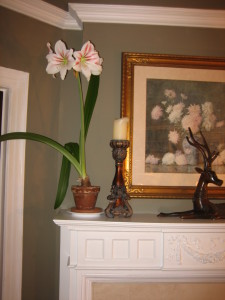
“An astounding “jaguar” amaryllis has erupted into bloom in our reading room, without leaves and on a bare stalk over a yard high.”
The house was quiet this morning and nothing much is going on in the garden, which is only enlivened by a rabbit for Cosimo to chase every now and then, the constant one-note from the cardinals, whose cheery “peet” can be heard distinctly from inside, and the resident groups of Carolina wrens – one group in the pyracantha, one in the yew by the garage, and a new group in the wisteria, now large enough to provide sufficient shelter. They fly back and forth, pyracantha to the garage to the wisteria and back again, paying each other holiday visits and twittering about the neighborhood gossip in a friendly way that is charming to see.
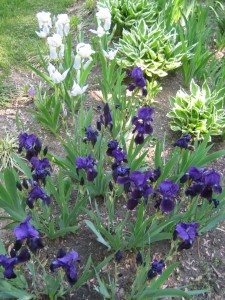
These are the irises that bloom a second time in late fall, often into December.
In the cold of the morning, I went outside to see if there was anything left in the garden that could be used to put a bouquet together. Not much, just the last of the roses and a few mums in sheltered spots. Mums really are good value, I think, though they are sometimes looked down on by gardening snobs as common. Not by the Japanese, of course, who have almost a reverence and religion for them, and glory in their beauty and hardiness in ways we could well learn from. They are so varied and interesting, practically pest-free, they bring color to the autumn garden when almost everything else is finished; plus, they have such a long season of bloom. What is not to like?
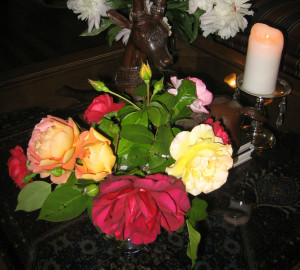
The last roses from the garden were brought indoors to make this small but cheerful bouquet.
Gardeners, though generally a cheerful and steady lot, don’t like to miss a chance to complain about the weather. And gardeners love to complain about the cold, even more than the heat, but perhaps less than the wreckage caused in the garden by a long hard drought or blast of late spring hail. For myself, I like the cold in winter, on the whole, and it brings the gardener many good things, like these:
- A hard freeze kills off lots of weeds and a huge variety of insect pests that blighted the garden during the entire growing season, and thank goodness that it does. The battle with bugs and weeds never ends, but we would not even stand a chance of staying on top of these tasks if the world was not destroyed and renewed in this seasonal way. Plus, the action of repeated freezes and thaws breaks up the soil and reduces the compost and mulch to valuable components of a healthy soil, saving the gardener weeks of back-breaking labor.
- When the garden is denuded of its luxurious summer growth and all the bushes are stripped bare, the gardener can learn a lot about the fundamental design of the garden. The underlying structure is candidly, perhaps cruelly, revealed. Try this experiment: the next time the garden is rimed with frost or etched in its outline by a light fresh snowfall, put on some warm clothes and go study it. What are your garden’s bones? Where does its design look weak or fall apart a bit? What are the main features, plantscape and hardscape, that give it structure and integrity? How do the foundational shapes flow through your garden landscape, or is it all just a big mash-up that can only look good when the plants return and cover up the underlying lack of design?
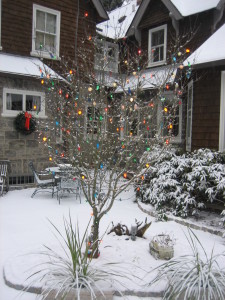
“Try this experiment: the next time the garden is rimed with frost or etched in its outline by a light fresh snowfall, put on some warm clothes and go study it.”
- Think about what you can change this spring to provide more structural integrity and design flow. Winter is a great time for the gardener to plan hardscape and planting changes to be implemented in the early spring, and observing the bare winter garden is a great way to start this process. As you do, don’t forget to consider not only plants’ flowers, but also their leaves; they flower for only a few weeks a year, but their leaves are in the garden for months.
- Just as tomatoes and other vegetables need a set number of hot days in summer to ripen fully, so do many plants – especially spring flowering bulbs – need a requisite number of days of cold to bloom, so think of every bitter winter day as so many more tulips, daffodils and crocuses safely in the bank.
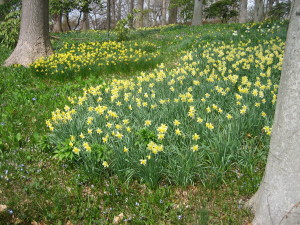
Glorious spring bulbs, like these over-the-top daffodils, cannot flower and thrive in spring without their requisite number of cold winter days.
- And of course it is not the case that you can’t enjoy the garden in winter. Far from it; many gardens are spectacular in winter and well worth the time to visit, including possibly your own. Whole books have been written about how to plan your garden so it looks great in winter, either through color or structure, and the gardener should not feel limited to being a three-season gardener. Some of my best days in this garden have been on mild winter days, when you can get outside and tend to light chores like pruning and general clean-up, and days like these are not to be missed.
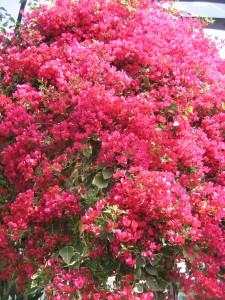
“There is always Mexico, Arizona and Florida, you know, if you are dying for hot sun and want to see some blazing bougainvillea when you wake up in the morning.”
- Finally, it is not a terrible thing for the gardener to be forced to loaf for a little bit of the year; and of course there is always Mexico, Arizona and Florida, you know, if you are dying for hot sun and want to see some blazing bougainvillea when you wake up in the morning. Your own garden may be perfectly beautiful, but even beauty needs to take a break, and there is something to be said for even the most beautiful of movie stars, for example, not to linger too long on the stage, for fear people will get tired of the gorgeousness of the overall effect. Change does us all good, really, garden and gardener alike.
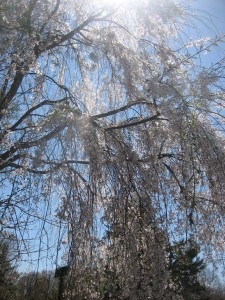
“I saw a most surprising sight: in the front yard of a house was a very large cherry tree (at least I think it was a cherry tree, it certainly looked like it) that was almost fully in bloom…”
Driving in to work yesterday, I was forced off my usual route by a road construction detour, onto a quiet suburban street I think I had never traveled before, and there I saw a most surprising sight: in the front yard of a house was a very large cherry tree (at least I think it was a cherry tree, it certainly looked like it) that was almost fully in bloom; not 100%, but more than 80%. It was a blizzard of white-pink, in December , creating a kind of Fellini-esque cinematic moment, something that could have been in “Amarcord” perhaps. How does something like that happen? It is funny how life sprinkles little surprises like these around the world; I remind myself to look for them more intently. So an epiphany descends, unexpectedly, during a hassled commute to work, and changes everything.
And yesterday, I hadn’t slept well and so got up early; as I came into the dark reading room, I noticed the computer was running our family slide show as a screensaver, so I sat down with a cup of coffee and watched in the dark room for about an hour. Sometimes we have to be made to observe the good things that fill our lives so abundantly. We get so caught up in all the day to day, worrying about all the little things that plague us, that we often lose sight of the big picture: that the lives we are living are great gifts that unfold beautifully and truly, just as they should. It is funny how these clarifying moments come upon us unawares. Advent is the time of joyful waiting and preparation, we are told, of confident hope in the present darkness, when we reflect that life is real and a gift, beautiful but fleeting.
Our house is decorated as charmingly as never before, with all the Christmas lights twinkling cheerfully. In these days, I get up early and drink lots of milky coffee and read whatever I feel like until it is time to go off to work with a happier heart, even after a disturbed night like this one. Christmas will soon be upon us in glorious earnest.



Dave, you forgot to mention Brazil as a destination: and of course there is always Mexico, Arizona and Florida, you know, if you are dying for hot sun and want to see some blazing bougainvillea when you wake up in the morning.
You’ll find not just bougainvillea, but also hibiscus, caesalpiniae, jasmine,solanaceae (manacá), Brazilian spiderflower, sunflowers,geraniums,Transvaal daisies, you name it. You are all very welcome to our summertime.
ON NOM DE CAFÉ…
Can you believe one of our most important writers named one of his children “1,2,3 of Oliveira 4?” One,two,three of oliveira four…